



Zhejiang passes regulation to boost maritime economy
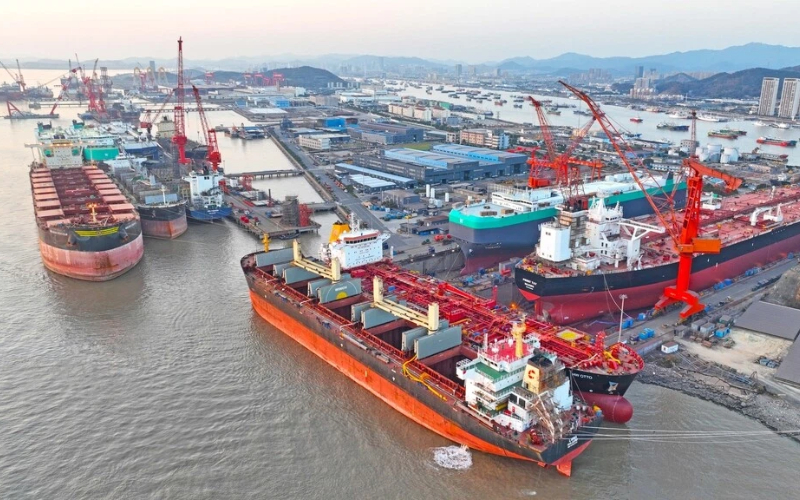
Vessels are under repair at a dock in Zhoushan, Zhejiang province, on Dec 16, 2025. [Photo/IC]
Zhejiang province has adopted its first comprehensive regulation dedicated to the maritime economy on Dec 23.
The regulation will take effect on March 1, 2026. The nine-chapter, 60-article regulation establishes a full-chain framework covering planning coordination, industrial development, technological innovation, port development, opening-up, green growth, and regulatory oversight.
Under the regulation, Zhejiang will position the building of a world-class port cluster as the core engine of its maritime strategy. This includes a port layout centered on Ningbo-Zhoushan Port, supported by coastal ports in southeastern Zhejiang and those around Hangzhou Bay, while linking inland facilities such as land ports in Yiwu and river ports.
Beyond upgrading traditional sectors such as shipbuilding and fisheries, the regulation supports the development of emerging industries, including maritime clean energy, new materials, biomedicine, and electronic information, to move the sector up the value chain.
Green development is a central pillar. The regulation introduces clearer rules on coastline protection, layered marine resource use, and ecological restoration. It also stipulates that construction projects within aquatic germplasm protection zones must submit special impact assessment reports, calling for a compensation mechanism for fisheries resource protection.
Zhejiang's maritime economy has continued to expand. In the first three quarters of this year, the province's gross ocean product reached 930 billion yuan ($132.59 billion), up 6.3 percent year-on-year.
As of Dec 24, Ningbo-Zhoushan Port's container throughput had surpassed 40 million TEUs for the first time, and is expected to exceed 43 million TEUs for the full year, representing year-on-year growth of more than 10 percent.
