



Winter camp solidifies cross-Strait youth ties
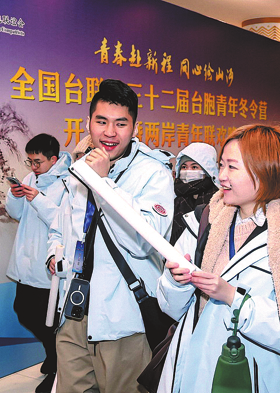
Taiwan youth visit Zhejiang University's Zijingang campus for tours and exchange activities in Hangzhou, Zhejiang province. [Photo provided to China Daily]
More than 1,000 young people from Taiwan gathered in Hangzhou, Zhejiang province, on Jan 21 as the 32nd Taiwan Compatriot Youth Winter Camp began, underscoring the continued expansion of cross-Strait youth exchanges and people-to-people ties.
The camp's opening ceremony, organized by the All-China Federation of Taiwan Compatriots, along with a cross-Strait youth gala, took place at the Zhejiang University campus.
Ji Bin, secretary of the Communist Party of China leadership group of the ACFTC, delivered the keynote address, describing the federation as a "home for Taiwan compatriots". He highlighted the close kinship and family bonds shared by people on both sides of the Taiwan Strait, adding that sustained youth exchanges play an important role in strengthening mutual understanding and emotional ties.
Ji encouraged participants to use the winter camp as an opportunity to travel, observe and experience firsthand all the developments on the Chinese mainland. He expressed hope that young people from Taiwan would take the time to build lasting friendships and contribute youthful energy to the peaceful and integrated development of cross-Strait relations.
Fu Qiang, deputy Party secretary of Zhejiang University, said the university has long been committed to talent cultivation, scientific research, social service and cultural heritage preservation, while actively promoting educational and cultural exchanges with Taiwan.
The university has over the years established close partnerships with a number of universities and research institutions in Taiwan, with frequent faculty and student exchanges and growing academic cooperation, Fu said. He added that Zhejiang University will continue to develop diversified, in-depth and sustainable platforms to support cross-Strait youth interaction.
Speaking on behalf of the Taiwan participants, a student surnamed Yang said young people on both sides of the Strait share the same language and cultural roots, and are strongly passionate in their pursuit of knowledge, innovation and future aspirations.
"Through exchanges like this, we hope to gain a deeper understanding of the continuity of Chinese culture and plant the seeds of long-term friendship and cooperation among young people from both sides," he said.
Tang Kun, a student volunteer from Zhejiang University, said young people across the Strait have grown up nurtured by the same cultural soil and share common historical memories. "We look forward to strengthening communication, deepening friendships and working together to build a shared future," Tang said.
On Tuesday, participants toured the Zhejiang University campus, attended a lecture on artificial intelligence, and visited facilities including a student innovation base for robotics and intelligent equipment, the university's science and technology museum, and its history museum. The activities offered participants an immersive look at the university's achievements in science and technology as well as its cultural heritage.
During their stay in Hangzhou, the group will also visit the Liangzhu Museum, the Archaeological Ruins of Liangzhu City and the China National Archives of Publications and Culture (Hangzhou branch) to explore the origins of Chinese civilization. They will also tour the Hangzhou Future Sci-Tech City exhibition hall, Alibaba's headquarters campus and several specialized high-end equipment enterprises to gain insights into innovation-driven development and the application of digital technologies on the mainland.
Launched in 1989, the Taiwan Compatriot Youth Winter Camp has attracted more than 9,000 young people from Taiwan. It has served as an important platform for fostering mutual understanding, learning and people-to-people connections among young people across the Strait.
This year's winter camp includes exchanges and tours across 24 provincial-level regions on the Chinese mainland.
 play
play