



Chongqing-Ningbo sea-rail transport enables seamless exports
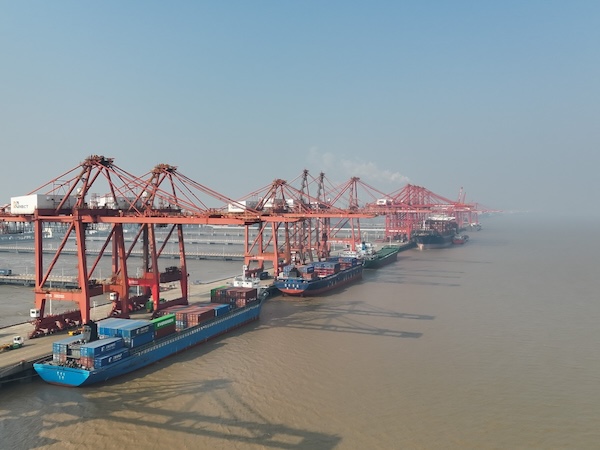
Beilun Port Area of Ningbo-Zhoushan Port. [Photo/Yongpai App]
China's sea-rail intermodal transport network reached a new milestone on Jan 24, when seven containers carrying new energy vehicles (NEVs) manufactured in Chongqing and bound for Myanmar were loaded onto a vessel at the Beilun Port Area of Ningbo-Zhoushan Port.
This marked the first time Chongqing-made NEVs were packed and inspected entirely at their place of origin before being transported by the Chongqing-Ningbo sea-rail service and shipped overseas without changing containers or being reopened for inspection. The process completely eliminates wait times between inland rail transport and maritime shipping.
The successful trial represents the first in Chongqing of Ningbo's "zero-wait" sea-rail transport mechanism. Developed jointly by the maritime authorities of Ningbo and Chongqing, the mechanism is designed to facilitate the export of China's "new trio" products — NEVs, lithium batteries and photovoltaic products — by extending efficient port services to inland regions.
Previously, exporters in Chongqing were required to ship cargo to Ningbo seven to 10 days in advance, and containers often had to sit idle at the port before loading. The new mechanism replaces this model with cross-regional joint inspections based on unified standards and mutual recognition. As a result, containers arriving at Ningbo-Zhoushan Port can be loaded directly onto outbound vessels.
The new process shortens the logistics cycle by one to two days per container, cuts time costs by up to 50 percent, and reduces logistics expenses by around 3,000 yuan ($431.23) per container.


 play
play